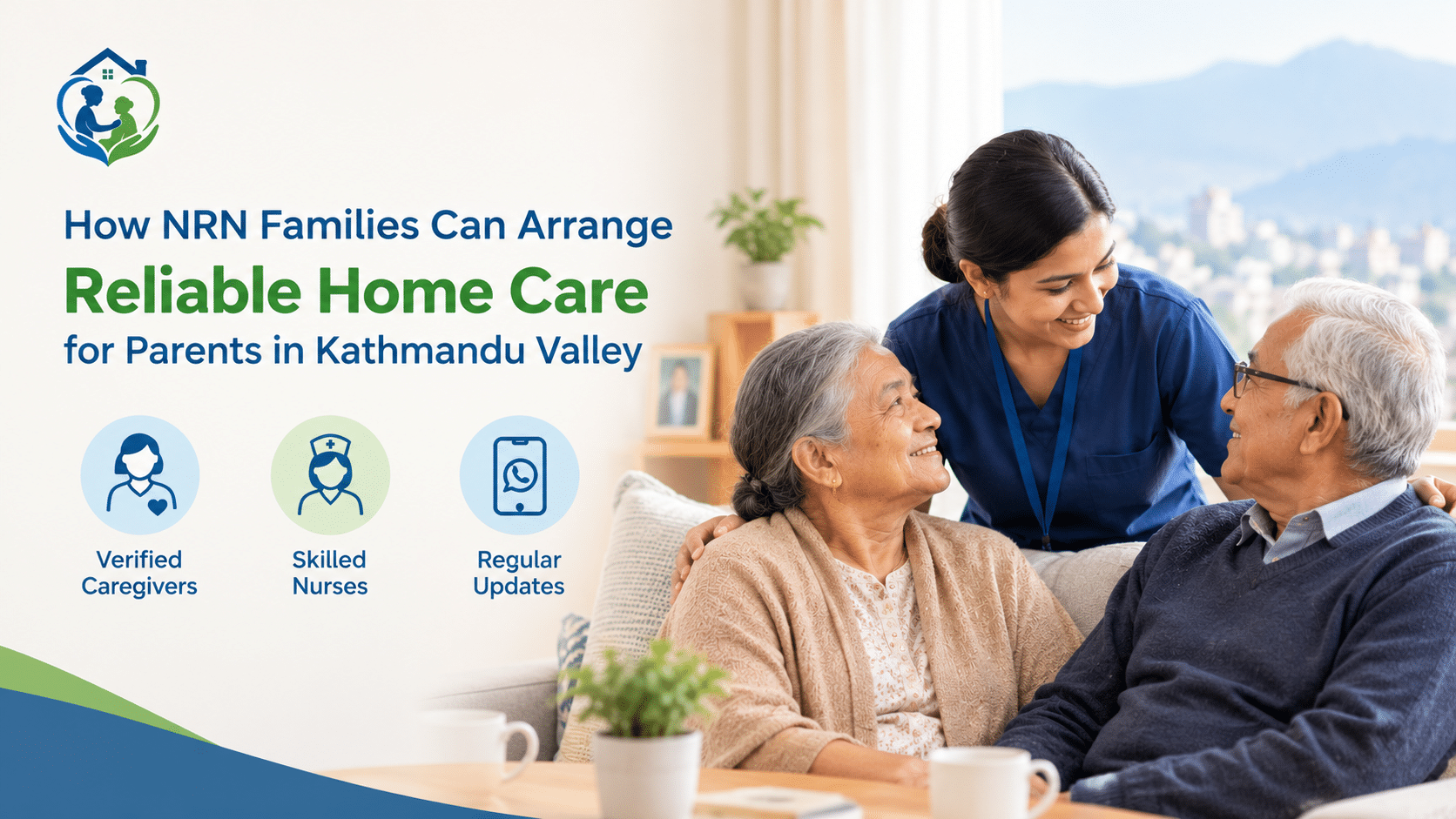
- Home Care for NRN Families in Kathmandu: What You Need to Know
- Why Distance Makes Parental Care Harder Than It Looks
- What Home Care Covers in the Valley
- How to Arrange a Caregiver from Abroad
- Start With a Plain Needs List
- Speak to the Provider Yourself
- Treat the First Week as a Trial
- Remote Monitoring of Parents in Nepal
- How to Judge Whether a Provider Is Reliable
- Where Families Commonly Go Wrong
- Frequently Asked Questions
- Can I arrange home care for my parents in Kathmandu while living abroad?
- How do I know a caregiver is trustworthy?
- What’s the best way to get updates on my parents from abroad?
- Should I choose a caregiver or a home nurse?
- How quickly can home care start for my parents?
- Taking the Next Step
Home Care for NRN Families in Kathmandu: What You Need to Know
Most NRN families can name the moment distance became a problem. For some it was a late-night call that went unanswered. For others it was a relative mentioning, almost in passing, that Aama had stopped taking her medicines regularly. Good care depends on small daily observations, like whether someone ate lunch or took their tablets, and those are very hard to make from another continent.
That’s where home care for NRN families in Kathmandu comes in. Done well, it puts a dependable person in your parents’ home and gives you an honest view of how they’re doing. This guide covers how to set it up, what to ask providers, and where families tend to go wrong.
Why Distance Makes Parental Care Harder Than It Looks
Nepal is ageing steadily. According to the 2021 census figures, people aged 60 and above made up 10.2% of the population, up from 5.8% in 1991. Over the same decades, more Nepali adults moved abroad for work and study, so a growing number of older parents live in Kathmandu, Lalitpur or Bhaktapur while their children live somewhere else entirely.
Most of the trouble comes from slow drift, such as meals skipped because cooking feels like too much effort, a bathroom that has become risky, or a loneliness nobody mentions on the phone. Relatives nearby often help generously, but they have jobs and families of their own, and goodwill alone can’t cover daily care.
What Home Care Covers in the Valley
Home care is a broad term, so it helps to separate two kinds of support. A caregiver service handles daily living: meals, help with bathing and dressing, walking with your parents, medicine reminders and company. If your parent is mostly independent but shouldn’t be alone for long stretches, this is usually the place to begin. Browsing the range of caregivers in Kathmandu also shows you what support exists before you speak to anyone.
Medical needs are different. Home nursing covers tasks that need clinical training, such as checking vital signs, managing wounds or following a doctor’s instructions after a hospital stay. Even a routine IV and injection schedule is safer in a nurse’s hands than a well-meaning relative’s.
Many families settle on a hybrid, with a caregiver most days and a nurse visiting on a set schedule. Nursing costs more, so it only makes sense where the medical need justifies it. For a wider view across the country, this overview of home care services is useful.
How to Arrange a Caregiver from Abroad
You can arrange a caregiver from abroad without flying home. The process just needs to happen in the right order.
Start With a Plain Needs List
Before contacting any provider, write down what your parents need in a normal day. It might read: help getting out of bed and bathing in the morning, a blood pressure check twice daily, lunch prepared to your father’s dietary limits, and someone to walk with your mother in the evening. Ask a relative in Kathmandu to read it over. They’ll almost always spot something you missed.
Speak to the Provider Yourself
Get on a video call and describe your parents as individuals, with their routines, the language they’re comfortable in, what they eat, what irritates them. A good provider asks follow-up questions and tells you plainly when a request is outside their scope. If it feels like a sales script, treat that as information.
Treat the First Week as a Trial
Families often commit for months before seeing the arrangement in action, which is the most avoidable mistake of all. A one-week trial lets your parents get used to a new face and lets you judge how updates arrive and how the caregiver handles the unexpected.
Picture a daughter in Toronto whose father lives alone in Patan. In week one, she learns he won’t eat before his morning walk, and that he’s more comfortable with a caregiver who speaks Newari at home. Small details like these shape a good match, and you only find them by watching the arrangement run. If possible, ask a relative to be there on day one.
Remote Monitoring of Parents in Nepal
Remote monitoring of parents in Nepal works best with a simple routine that everyone can keep, and no special equipment is required. For most families, WhatsApp care updates in Kathmandu are the practical answer, since the caregiver, your relatives and you are probably all on the app already. A short daily message covering meals, medicines, mood, and concerns is usually enough, and a twenty-second video of your parent saying hello tells you more than a paragraph of text.
Add a weekly summary noting appetite, sleep and mobility, which are often the earliest signs of trouble. Keep one shared document with the medicine list, the nearest hospital, and a relative’s phone number, so nobody has to search for details when something goes wrong at 3 a.m. Kathmandu time.
There’s a balance, though. Too many check-ins wear out a caregiver and can leave your parents feeling watched. Explain the plan to them first and keep it light. Their dignity matters as much as their safety.
How to Judge Whether a Provider Is Reliable
Nearly every provider calls itself trusted and experienced, so your questions do the work. Ask how staff are identity-checked and whether you can see evidence. Ask for duties, hours, and days off in writing. Ask what happens if the caregiver falls ill or leaves, since a clear replacement plan separates organised services from informal ones. If nursing is involved, confirm the person doing medical tasks is qualified for them.
Ask what the provider won’t do, too. An honest “that needs a doctor” is a better sign than a promise to handle everything. And before committing to anyone, including us, read their About Us page to see who’s behind the service.
Where Families Commonly Go Wrong
The recurring problems are surprisingly consistent. Some families hire through a friend of a friend with no backup arrangement, which works until the day the helper doesn’t turn up. Others skip the trial or leave duties and update routines undefined, so they quietly drift. A surprising number arrange everything without telling their parents, which can leave the caregiver feeling like an intruder.
Choosing between options takes honesty as well. Relatives are warm but can burn out. Informal helpers are flexible but usually unverified. A structured provider costs more but brings training, replacement cover and accountability. An old-age home suits some parents, yet many prefer their own house, familiar rooms and neighbours, and for them home care is the more natural fit.
Frequently Asked Questions
Can I arrange home care for my parents in Kathmandu while living abroad?
Yes. The whole process can be done by phone and video: write down your parents’ needs, speak to the provider, run a one-week trial, and agree on an update routine. It helps to have one relative nearby on the first day, but you don’t need to travel.
How do I know a caregiver is trustworthy?
Ask the provider how staff is identity-checked and request the caregiver’s duties in writing. Then judge the arrangement during the trial week. Consistent daily updates, a clear replacement plan, and honest answers to difficult questions are all good signs.
What’s the best way to get updates on my parents from abroad?
A short daily WhatsApp message works for most families, covering meals, medicines, mood, and concerns. Add a weekly summary and an occasional video call with the caregiver present, so you can see how your parents look and sound. Agree on timing that suits your time zone.
Should I choose a caregiver or a home nurse?
It depends on the need. A caregiver suits daily help like meals, bathing, walking, and company. A nurse is needed for medical tasks such as injections, wound care, or monitoring after surgery. Many families combine a daily caregiver with scheduled nurse visits.
How quickly can home care start for my parents?
That depends on your parents’ needs and the provider’s availability, so ask for a realistic start date on your first call. Plan the trial week around it, and try to have a relative present on day one so the start feels familiar and unhurried.
Taking the Next Step
You can’t be in Kathmandu every day, but you can build an arrangement where a trained person is there, and you hear from them daily. Start with the needs list, speak to the provider yourself, run the trial week, and keep the updates simple enough to last. For background on helping older people stay independent for longer, WHO’s ageing guidance is a good place to read further.
If you’d like to talk through your parents’ situation, contact us, and we’ll help you work out what kind of support makes sense.