- What Home Nursing Actually Means in Nepal
- Home Nursing vs Hospital Care: Where the Real Costs Come From
- What You’re Paying For in a Hospital Stay
- What You’re Paying For With Home Nursing
- Comfort, Recovery and Safety: The Non-Financial Side of the Decision
- When Hospital Care Is Still the Better Choice
- How to Decide: A Simple Checklist for Nepali Families
- What to Look for When Hiring a Home Nursing Provider in Nepal
- Frequently Asked Questions
- Is home nursing actually cheaper than a hospital stay in Nepal?
- What’s the difference between a home nurse and a home caregiver?
- Can home nursing handle serious medical conditions?
- How quickly can a home nurse be arranged after hospital discharge?
- Does health insurance in Nepal cover home nursing?
- What happens if the patient’s condition worsens at home?
- Making the Right Call for Your Family
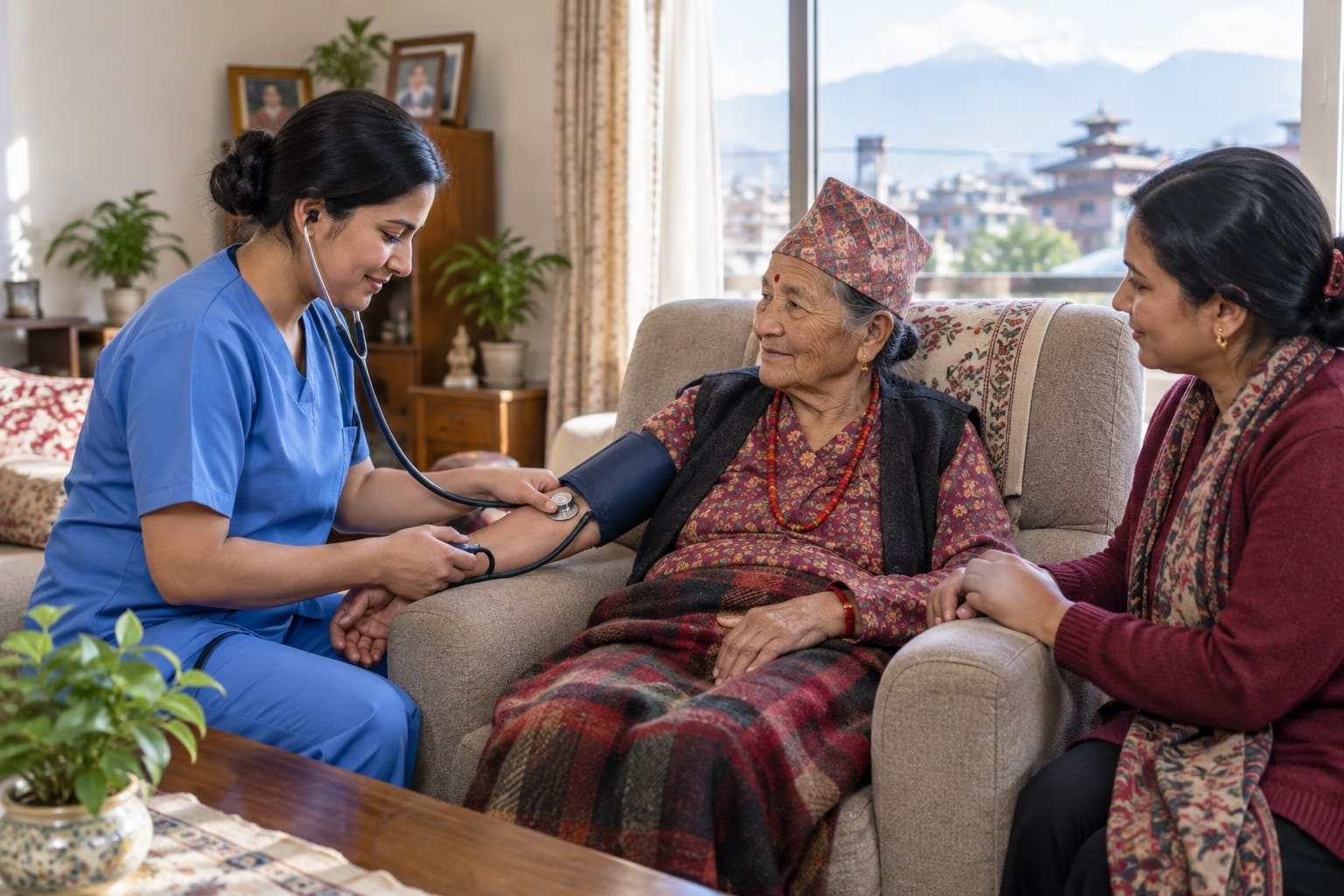
Choosing between home nursing and hospital care in Nepal comes down to one thing: is the patient medically stable enough to recover at home? Home nursing in Nepal means a trained nurse provides medical care, such as wound dressing, injections, vital signs monitoring, and medication management, inside your own home instead of a hospital ward. Hospital care remains essential for emergencies, surgery, and intensive monitoring. For stable patients recovering from illness, surgery, or managing a chronic condition, home nursing is often more comfortable and can reduce the total cost of extended care. The right choice depends on the patient’s medical condition, not on price alone.
What Home Nursing Actually Means in Nepal
Home nursing isn’t the same as hiring a general caregiver. A home nurse in Nepal is typically a registered or licensed nursing professional who can perform clinical tasks: administering injections, changing surgical dressings, managing catheters, monitoring vital signs, and coordinating with your family doctor. If you’re not sure whether your loved one needs a nurse or a caregiver, start with our guide on signs your elderly parent may need professional home care support, since the level of medical need determines which service fits.
Here’s the thing: families in Kathmandu often assume “home nursing” and “home care” are interchangeable. They’re not. Home care covers daily living support, bathing, mobility, and companionship. Home nursing adds a licensed clinical layer on top of that. Many families end up needing both, which is why services like skilled home nursing services in Nepal are usually built to flex between the two.
Home Nursing vs Hospital Care: Where the Real Costs Come From
Let’s be honest, most families don’t compare home nursing and hospital care by reading a brochure. They compare it by looking at the bill. So it’s worth breaking down what you’re actually paying for in each setting.
What You’re Paying For in a Hospital Stay
A hospital stay in Kathmandu isn’t just the bed charge. You’re paying for the room or ward, round-the-clock nursing staff, doctor visits, diagnostic tests, medicines dispensed through the hospital pharmacy, and often an attendant fee if the hospital requires a family member to stay. These costs stack up fast, especially for a recovery period that stretches beyond a few days. A stable patient who no longer needs hospital-level monitoring but still needs professional nursing care ends up paying hospital rates for a service that could be delivered at home.
What You’re Paying For With Home Nursing
With home nursing, you’re generally paying for the nurse’s time, either per visit, per shift, or on a live-in basis, plus any medical supplies used during care. There’s no room charge, no attendant fee, and no hospital pharmacy markup. Costs vary depending on how many hours of coverage you need and the complexity of the care, so it’s worth getting a personalized quote rather than assuming a fixed number. Academic research on long-term care spending backs this up in principle: a comparative review of home-based versus institutional care found that home-based care can be a lower-cost alternative to institutional long-term care, particularly for less dependent patients who have access to informal caregiver support.
Comfort, Recovery and Safety: The Non-Financial Side of the Decision
Cost matters, but it shouldn’t be the only factor. Recovering at home, in a familiar bed, with family nearby, tends to reduce stress for both the patient and the caregivers around them. That’s not just a feel-good claim. A nationwide inpatient study on elderly patients found that home medical care initiated at discharge has been linked to a lower risk of rehospitalization, building on earlier evidence that home-based palliative care reduces readmissions and improves patient satisfaction. In other words, the comfort factor and the clinical outcome aren’t separate things; they’re connected.
There’s also a practical safety angle most people don’t think about until it’s too late: hospital-acquired infections. A patient with a weakened immune system, an open wound, or a recent surgery is exposed to a different set of risks in a shared hospital ward than they are at home. This doesn’t mean hospitals are unsafe; it means the risk profile is different, and that’s worth weighing honestly.
When Hospital Care Is Still the Better Choice
This isn’t a home nursing sales pitch, so let’s be clear about when hospital care is the right call. If the patient is unstable, needs ICU-level monitoring, requires surgery, or needs equipment that can’t reasonably be brought into a home setting, hospital care is not optional. Home nursing works best for the recovery phase, not the emergency phase. A good home nursing provider should tell you this directly instead of trying to keep every case at home regardless of medical need.
How to Decide: A Simple Checklist for Nepali Families
- Is the patient medically stable? If yes, home nursing becomes a realistic option. If no, hospital care comes first.
- What level of monitoring is needed? Daily vitals and wound care can usually move home. Continuous ICU-level monitoring cannot.
- Is there a safe space at home? A clean, accessible room with space for a nurse to work matters more than people expect.
- Who’s around to help? Even with a nurse, having family nearby for the hours a nurse isn’t present makes a real difference. If you also need daily support, not just clinical care, it’s worth reviewing home caregiver services in Kathmandu alongside nursing care.
- What does the doctor recommend? Always confirm the shift from hospital to home with the treating physician before moving.
What to Look for When Hiring a Home Nursing Provider in Nepal
Not every home nursing service in Nepal operates at the same standard, so it pays to ask direct questions before you commit. Confirm the nurse’s registration and qualifications. Ask how medication is tracked and administered, since medication management support at home is one of the most common reasons home nursing goes wrong when it’s handled carelessly. Ask what happens in an emergency: is there a doctor on call, and how fast can the patient be moved back to a hospital if needed? A provider that can answer these clearly, without hesitation, is usually one you can trust.
Frequently Asked Questions
Is home nursing actually cheaper than a hospital stay in Nepal?
In most cases, yes, especially for extended recovery periods, because you’re not paying for room charges, hospital overheads, or attendant fees. The exact savings depend on the patient’s needs, so it’s best to compare a hospital’s daily rate against a personalized home nursing quote.
What’s the difference between a home nurse and a home caregiver?
A home nurse is a licensed medical professional who can perform clinical tasks like injections, wound care, and medication management. A caregiver supports daily activities like bathing, mobility, and companionship but isn’t licensed for clinical procedures.
Can home nursing handle serious medical conditions?
Home nursing can manage many post-surgical, chronic, and recovery-phase conditions, but it’s not a substitute for hospital care when a patient is unstable or needs intensive monitoring. Your doctor should confirm the patient is stable enough for home-based care first.
How quickly can a home nurse be arranged after hospital discharge?
This depends on the provider, but a well-organized home nursing service should be able to arrange care within a day or two of discharge, especially if you contact them before the patient actually leaves the hospital.
Does health insurance in Nepal cover home nursing?
Coverage varies by insurer and policy, so it’s important to check directly with your insurance provider before assuming home nursing costs are covered.
What happens if the patient’s condition worsens at home?
A reliable home nursing provider will have a clear escalation plan, including on-call doctor access and a fast path back to hospital admission if the patient’s condition changes.
Making the Right Call for Your Family
There’s no universal right answer between home nursing and hospital care; it genuinely depends on the patient’s condition, the family’s situation, and what the treating doctor recommends. What matters is making that decision with clear information instead of guessing. If you’re weighing this choice for a loved one in Kathmandu or anywhere in Nepal, talk to a home nursing provider before you decide, not after, so you know exactly what’s possible at home and what still needs a hospital.